Vastu API: floor plan, mandala, 16 zones, report
You send the floor plan: the outline, the angle to north, the rooms, fixtures and the main door, in image pixels or in metres. You get back where each room sits from the centre, what the texts say about it, what can be done, and a picture you can lay straight over the plan.
What the API returns
Section titled “What the API returns”| Endpoint | Credits | What it returns |
|---|---|---|
POST /v1/vastu/plan | 20 | For every room and fixture its bearing, 8, 16 and 32 sector, mandala cell and deity, verdict with its source; the door pada; the outline’s shape; findings with remedies; a score with its band |
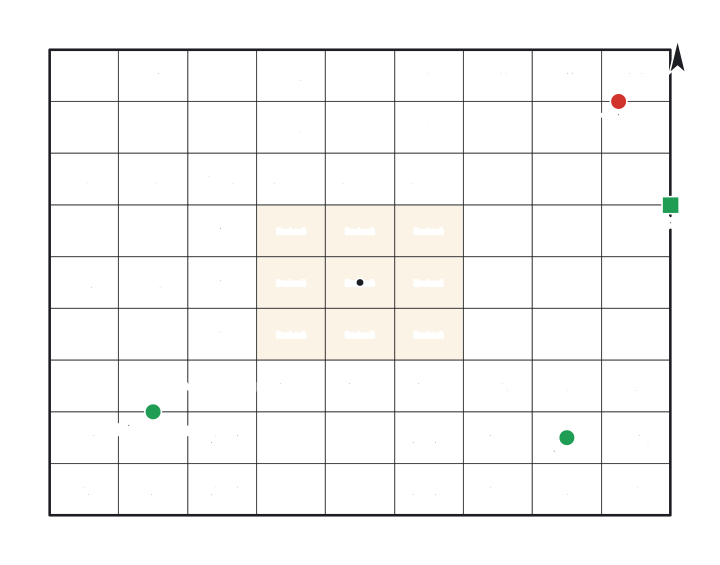
POST /v1/render/vastu | 20 | SVG in the plan’s coordinates on a transparent background: mandala, 16 zones or 8 directions |
POST /v1/reports/vastu | 5000 | A PDF report under your brand, in English or Ukrainian; also HTML or Markdown (format) |
POST /v1/vastu/zones | 10 | 8, 16 or 32 sectors with exact bounds and, given a plan, what lies in each zone |
POST /v1/vastu/rooms | 10 | Verdicts and a score by direction, when the plan is already measured |
POST /v1/vastu/entrance | 10 | The main door’s pada and its result |
POST /v1/vastu/mandala | 10 | The whole mandala: 45 deities and their cells |
POST /v1/vastu/directions | 10 | The eight directions with guardians, planets and classical rules |
Every field, example and error code: the Vastu docs.
Where the rules come from
Section titled “Where the rules come from”Every verdict carries basis. classical means a verse stands behind it, and the source names it: Brihat Samhita, chapter 53 (Iyer’s 1884 translation, with the Sanskrit checked for the shape of the site), Mayamata for the second classical school, Muhurta Chintamani 12.21 for the rooms of the sixteen zones. convention means modern practice with no verse, and says so.
Three schools to choose from: brihat-samhita (the default), mayamata and sixteen-zone. The classical schools read bearings from the centre of the mandala rectangle, the sixteen-zone school from the centroid of the area; the response always says which.
What we do not do
Section titled “What we do not do”- We do not read the plan from an image. You send the geometry yourself, so the picture of the plan, with the address on it, never leaves your device: we receive only the coordinates of the outline, rooms and door.
- We promise no result. Remedies carry their effort and whether they can be undone, but none promises that anything will change. We sell nothing: no pyramids, yantras or figurines.
- We invent no rules. A placement no source covers gets
no-ruleand stays out of the score.
Who it is for
Section titled “Who it is for”- Proptech and estate agents: a reading of the floor plan next to the other facts about a property.
- Architects and interior designers: checking a sketch against the classical rules before the drawings.
- Vastu consultants: a report under your own brand in a minute instead of working it out by hand.
- Astrology platforms: Vastu beside the chart, with the same key and the same credits.
Questions
Section titled “Questions”How do I give north if I only have a compass? Send the angle, northReference: "magnetic" and the declination for your site. Without the declination the answer is 400: the rules are read from true north.
What about an L-shaped plan? Its centroid falls outside the plan. The response warns about it, the classical schools read from the centre of the mandala rectangle, and the cells in the cut-out are marked outsideContour.
What does the report cost? 5000 credits, like the other PDF reports. Reports are not on the free plan; the 10 and 20 credit calculations are.